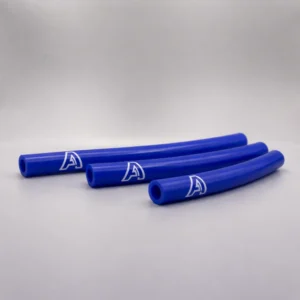
Bright silicone hoses have become almost synonymous with an “upgrade” in the motorcycle world. But colour isn’t engineering.
When comparing silicone vs rubber vacuum hoses on a motorcycle, the real question isn’t appearance —it’s performance and suitability for the environment in which the hose operates. The real question isn’t whether silicone looks better, it’s whether it performs better — and in which environments.
That’s the engineering approach taken at Tiger Forge Designs.
To answer that properly, we need to look at what “rubber” usually means in OEM applications, how it behaves over time, and where silicone fits.
What “Rubber” Typically Means
When riders refer to rubber hoses on a motorcycle, they’re usually talking about one of three materials:
• EPDM (Ethylene Propylene Diene Monomer) – commonly used in coolant and vacuum systems
• NBR (Nitrile Rubber) – used where oil or fuel resistance is required
• Blended automotive elastomers
Each has different chemical and mechanical behaviour. They are not interchangeable, Silicone belongs to an entirely different polymer family.
Silicone as a Hose Material
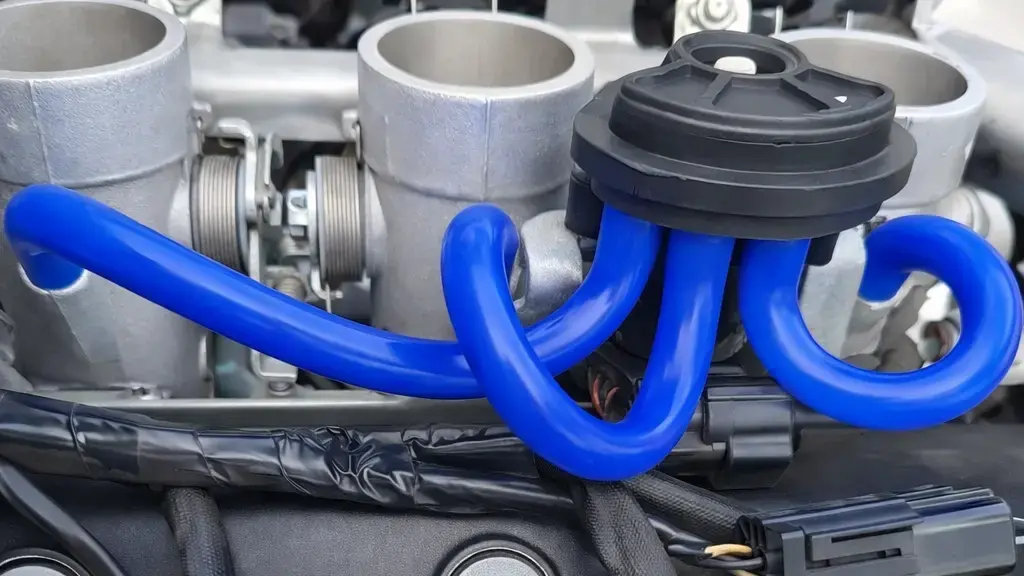
Silicone’s reputation largely comes from performance cooling systems — and for good reason.
Where Silicone Excels
• Excellent high-temperature stability compared with conventional rubber compounds
• Strong resistance to UV and environmental degradation
• Stable across repeated thermal cycling
• Maintains flexibility over long service periods
• Resistant to coolant and water-based fluids
One of silicone’s biggest advantages is long-term elasticity. Where conventional rubber compounds progressively harden, silicone tends to retain flexibility for significantly longer. In cooling systems and vacuum circuits — where flexibility and sealing consistency matter — that stability is valuable.
Where Silicone Is Not Ideal
• Poor resistance to petrol and many oils (unless specifically lined)
• More expensive than standard rubber compounds
• Lower tear resistance than some reinforced elastomers
Material choice must follow environment. Silicone is excellent for coolant and vacuum use. It is not automatically suitable for fuel systems without specialised construction.
EPDM Rubber in OEM Applications
OEM manufacturers typically fit EPDM vacuum hoses at the factory.
EPDM is cost-effective, easy to manufacture at scale, and performs reliably within its intended service window. For new machines operating under warranty periods, it is an entirely rational material choice. Over time, repeated thermal cycling and environmental exposure lead to hardening, loss of elasticity, and surface cracking — particularly at hose ends and tight bends.
This is not a rare defect. It is the normal ageing behaviour of the material.
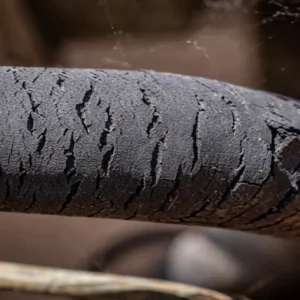
Similar ageing behaviour can be seen in many rubber motorcycle components, such as bushings and protective boots, something we explore further in our TPU vs EPDM durability comparison
On older motorcycles, failed vacuum hoses are rarely the result of sudden damage. They are almost always the result of age-related elasticity loss. Vacuum lines do not require fuel resistance. What they require is long-term flexibility and dimensional stability. In this environment, silicone’s resistance to thermal ageing and environmental degradation offers a clear durability advantage over conventional EPDM.
NBR (Nitrile Rubber)
NBR is commonly used in fuel and oil-contact applications.
Strengths
• Good resistance to petrol and hydrocarbons
• Suitable for fuel lines and oil seals
• Good mechanical toughness
Limitations
• Poor UV resistance
• Narrower temperature range than silicone
• Can harden under prolonged heat exposure
Where fuel resistance is required, NBR is often the correct engineering choice. Where long-term environmental stability is required without hydrocarbon exposure, silicone has advantages.
Real-World Comparison
| Property | Silicone | EPDM | NBR |
| Coolant Resistance | Excellent | Excellent | Moderate |
| Oil Resistance | Poor | Poor | Good |
| Fuel Resistance | Poor | Poor | Good |
| UV / Environmental Stability | Excellent | Good | Poor |
| High Temperature Stability | Excellent | Moderate | Moderate |
| Long-Term Elasticity | Excellent | Degrades with age | Degrades with heat |
The Engineering Perspective
There is no universally “best” elastomer.
There is only:
• Correct material
• Correct environment
• Correct application
Silicone is not a cosmetic upgrade. It is a material with specific performance characteristics — particularly in environments demanding long-term flexibility and temperature stability.
EPDM remains widely used because it meets production cost targets and performs adequately within predictable service life. NBR exists because hydrocarbon resistance is sometimes essential, understanding those distinctions matters more than marketing claims.
Final Thought
If you are maintaining an ageing motorcycle and replacing vacuum hoses that have hardened and cracked, that failure is not surprising. It is expected behaviour from a conventional elastomer after years of service. Material selection should aim not only to replace a part, but to reduce the likelihood of the same ageing mechanism repeating. On a motorcycle, environment dictates longevity — choose accordingly.
Tiger Forge Designs vacuum hose sets are produced from automotive silicone hose selected for dimensional stability and long-term flexibility in vacuum applications.