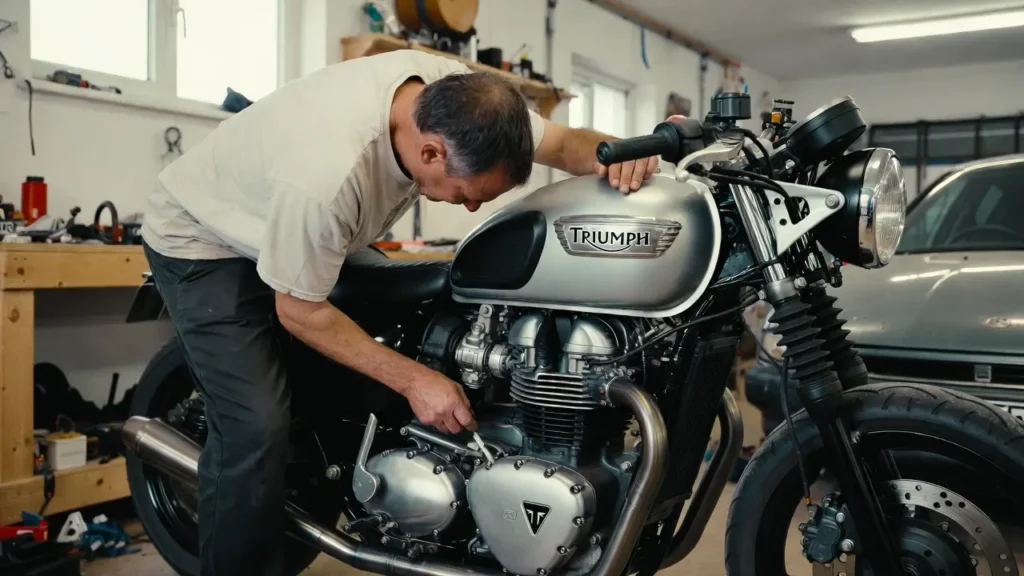
It’s that time of year again when cold, wet and dreary weather begins to give way to something a little more agreeable for us leisure motorcyclists. Covers are coming off, and many bikes are getting their annual bit of fettling and checking over ready for the riding season ahead.
While you’re oiling the chain and working through the usual pre-season jobs, it’s worth remembering one thing that often gets overlooked. The fuel in the tank – motorcycles that have been sitting for a while often develop running issues that seem mysterious at first.
- Hard starting.
- Rough idle.
- Poor throttle response.
Owners sometimes assume something serious has gone wrong — sensors, fuel pumps, injectors, electronics. But in the end the culprit is often much simpler — old fuel!
Modern Petrol Doesn’t Age Gracefully.
Modern petrol is a carefully blended mixture of volatile hydrocarbons designed to ignite efficiently inside an engine. The problem is that those same properties make it surprisingly unstable over time. When fuel sits in a tank for months, several things begin to happen:
Light fractions evaporate – the components that help fuel ignite easily slowly disappear.
Oxidation begins – the fuel starts to form sticky compounds often referred to as “gum” or varnish.
Ethanol absorbs moisture – which can introduce water into the fuel system.
Deposits can form – particularly in injectors, carburettor jets, and small fuel passages.
In other words, petrol slowly turns from a carefully engineered fuel into something closer to uncooperative soup.
Why Motorcycles Are Especially Sensitive
Motorcycles tend to suffer more from old fuel than cars for a few simple reasons.
Fuel tanks are smaller, so the fuel ages more quickly. Bikes sit unused for longer periods and motorcycle fuel systems — particularly injectors and carburettor circuits — contain very small passages that don’t appreciate sticky residues.
The result is often:
- difficult starting
- uneven idle
- hesitation on throttle
- general grumpiness from an otherwise healthy engine
The Good News
Fortunately, this is often one of the easier problems to fix. If a bike has been sitting for months, the first step should almost always be fresh fuel. In many cases simply draining the old petrol and refilling with fresh fuel restores normal running. Once the engine runs long enough to flush the system through, many symptoms disappear.
Mechanics have lost count of the number of “serious faults” that turned out to be nothing more exotic than stale petrol.
Preventing the Problem
For older motorcycles, E5 is always the preferred choice over E10, particularly if the petrol will remain unused in the tank for an extended period. Its lower maximum ethanol content reduces the moisture absorption and material-compatibility problems associated with ethanol.
If your bike is going to sit unused for several months, there is then a separate question: how much fuel should be left in the tank? That depends largely on what the tank is made from.
With a metal tank, filling it with fresh E5 petrol to the manufacturer’s normal maximum level reduces the air space in which condensation can form and helps protect the inside from corrosion. Leave the intended expansion space and consider adding a fuel stabiliser suitable for ethanol-blended petrol.
A plastic tank cannot rust internally, so there is no corrosion-prevention reason to leave it full. If the tank is known to swell, distort or develop paint blisters after prolonged exposure to ethanol-blended petrol, drain it correctly before storage rather than filling it—even with E5. Do not attempt to empty a fuel-injected system by running the fuel pump dry.
On carburetted motorcycles, drain the float bowls so that petrol cannot evaporate and leave gum or varnish behind in the jets and small fuel passages.
If you use a fuel stabiliser, add it before the final ride so that the treated fuel circulates through the system. Once your bike is laid up, do not start it periodically simply to let it idle. Water vapour is produced during combustion, and a brief run may not get the engine oil and exhaust system hot enough to drive that moisture off. If the bike is used during winter, take it for a proper ride; otherwise, leave it alone.
Workshop Reality
When a bike starts misbehaving after sitting for a while, it’s easy to assume the worst: sensors, injectors, fuel pumps, electrical gremlins.
In reality, the first thing many mechanics check is much simpler — the age and condition of the fuel in the tank. Petrol isn’t designed for long-term storage. Given enough time it degrades, and engines that normally run perfectly can become temperamental simply because the fuel has changed.
It’s also worth keeping in mind that stale fuel isn’t the only thing that can cause these symptoms. Air leaks elsewhere in the system can produce very similar behaviour — particularly on older bikes where rubber components have begun to harden and crack.
On the Triumph 955i in particular, ageing vacuum hoses are known to fail this way. When they start to deteriorate, they can introduce air leaks that upset fuelling and idle stability in a way that can look like fuel-related issues. See the vacuum hose set for a direct replacement option.
Final Thoughts
Fuel quality plays a bigger role in motorcycle reliability than many riders realise. Modern petrol varies in ethanol content, which affects storage stability and how it interacts with hoses, seals, and other rubber components. Over time this contributes to the swelling, hardening and cracking many riders eventually see in older hoses, something we explore in more detail in our silicone vs rubber hose comparison.
Ultimately, before dismantling half the motorcycle, it’s worth remembering one simple workshop truth — sometimes the most advanced diagnostic tool in the garage is simply fuel that wasn’t brewed last season.
Related Workshop Notes
- E5 vs E10 Petrol for Older Motorcycles – Why Many Riders Prefer E5
- Silicone vs Rubber Hoses – What’s the Difference?
Related Components