Why Material Choice Matters
Material selection plays a significant role in the performance and longevity of elastomer components used on motorcycles. Rubber and flexible parts are exposed to heat cycling, environmental conditions, compression and vibration over extended periods of time. As these components age, material behaviour influences how well they maintain their intended function and dimensional stability.
Different elastomers exhibit different ageing characteristics. Understanding those differences is important when selecting a suitable material for replacement components.
What is EPDM?
EPDM (Ethylene Propylene Diene Monomer) is a widely used thermoset automotive rubber compound. It is commonly found in seals, gaskets, mounts and protective trim components due to its resistance to ozone, weathering and environmental exposure.
As a vulcanised rubber, EPDM is cured during manufacturing and cannot be reprocessed once formed. It performs well in many external applications and has been used extensively in original equipment production.
Over time, however, repeated heat cycling and environmental exposure cause elastomeric materials to harden, lose elasticity and develop surface cracking. This behaviour is typical of many conventional rubber compounds as they age.
What is Thermoplastic Polyurethane (TPU)?
Thermoplastic Polyurethane (TPU) is an elastomeric thermoplastic material combining flexibility with controlled dimensional stability. Unlike thermoset rubbers, TPU does not require vulcanisation and can be reheated and reprocessed during manufacturing.
TPU offers excellent abrasion resistance and high tear strength while maintaining flexibility under repeated compression. It also demonstrates good resistance to oils and many automotive fluids compared to conventional rubber compounds. In addition, TPU exhibits inherent vibration damping characteristics, which can be beneficial in applications involving compression or oscillating loads when appropriately engineered.
In motorcycle applications, TPU is well suited to components requiring elasticity alongside structural consistency, particularly where mechanical wear is a factor.
Hardness and Behaviour
Elastomer materials are commonly described using Shore hardness ratings. Many original EPDM motorcycle components are produced at commonly lower Shore A hardness ratings.
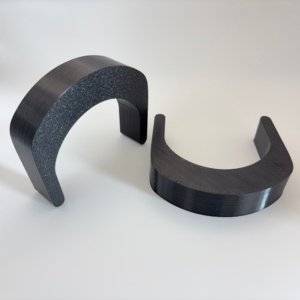
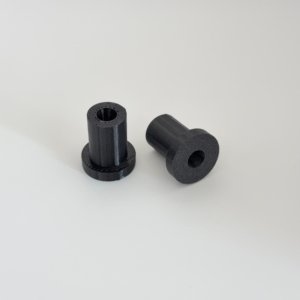
Tiger Forge Designs currently produces selected components in 95A Shore Thermoplastic Polyurethane (TPU), chosen to provide an appropriate balance between flexibility and support for trim and mounting applications.
Shore hardness alone does not fully define how a component behaves in service. Material thickness, geometry and internal structure all influence flexibility, compression response and long-term durability.
Additive manufacturing enables geometry to be intentionally designed into the component. Wall thickness, reinforcement features and controlled flex regions can be incorporated during development, allowing overall behaviour to be tuned for its specific application.
Key Material Characteristics
| Material Type: | EPDM – Thermoset rubber | TPU – Thermoplastic elastomer |
| Ozone & Weather Resistance: | Excellent | Very good |
| Heat Cycling Resistance: | Very good | Good |
| Abrasion Resistance: | Moderate | Excellent |
| Tear Strength: | Moderate | High |
| Oil & Fluid Resistance: | Moderate | Good to very good |
| Recyclable | No | Yes |
| Manufacturing Method: | Vulcanised moulding | Additive manufacturing |
Both materials have appropriate uses depending on application requirements.
Manufacturing Considerations
Injection moulding remains the standard process for high-volume production of elastomer components. It is efficient and repeatable, but requires dedicated tooling and curing processes.
Additive manufacturing removes the need for mould tooling. Components can be produced directly from digital models, enabling controlled dimensional accuracy and viable small-batch production. Complex geometries can be created without additional tooling cost, making it practical to support lower-volume or ageing motorcycle platforms.
Thermoset rubbers such as EPDM cannot be reprocessed once cured. Thermoplastic elastomers such as TPU are recyclable materials, as they do not undergo permanent chemical curing.
Additive manufacturing also reduces the material waste typically associated with tooling and mould development, as components are produced directly from digital models without the need for mould fabrication.
Application Considerations
Material selection depends on the intended function of the component and the environment in which it operates. Both EPDM and Thermoplastic Polyurethane (TPU) are suitable materials when applied appropriately.
EPDM has a long history of use in automotive sealing and weather-exposed components. In some cases, original EPDM components for older motorcycle platforms are no longer manufactured or readily available. In these instances, a carefully engineered TPU alternative provides a practical and durable solution.
When combined with additive manufacturing, TPU components can be designed to achieve the required balance of flexibility, abrasion resistance and structural support for their intended application.
Application Within Tiger Forge Designs Components
Selected Tiger Forge Designs components are currently produced in 90-95A Shore Thermoplastic Polyurethane (TPU), chosen according to the functional requirements of each part.
Examples include:
– Side pannier bump stops
– Mirror stem boots
– Tank mounts
– Coolant reservoir cover
Each application is evaluated individually, with material and geometry selected to suit its intended use.
Similar material considerations also apply when comparing hose materials used on motorcycles. For a more detailed discussion of hose materials, see our silicone vs rubber vacuum hose comparison.
Related Workshop Notes
• E5 vs E10 Petrol for Older Motorcycles – Why Many Riders Prefer E5
• Why Old Petrol Causes Running Problems in Motorcycles
Related Components